
Do you wish to work as a Korean learner at a Korean company or government agency in South Korea or globally?
Then, you can consider the KLAT (Korean Language Ability Test).
This is accepted wherever documentary evidence of the Korean language is required.
What is KLAT?
The Korean Language Ability Test (세계한국말인증시험), or KLAT, is a standardized Korean test administered in South Korea and worldwide.
The Korean Language Proficiency Test (KLPT) was formerly known is the Korean Language Proficiency Test.
They developed this exam to evaluate the Korean ability of non-native Korean speakers.
The test uses an evaluation system that assesses the target’s specificity and the goal of measuring the ability to communicate in Korean.
It assesses the skills of foreigners and overseas Koreans who don’t speak Korean as a mother tongue.

Who conducts the KLAT test?
The Korea Educational Testing Service (KTES) administers the exam globally. It operates under the Ministry of Culture, Sports, and Tourism of the Republic of Korea.
Recognition and Acceptance
While this is not as widely known as TOPIK, KLAT is also a well-known Korean language test. If you want your Korean proficiency to be assessed officially, you can take the assessment.
This is one of the official language tests authorized by the government of South Korea.
Purposes of the KLAT Test
There are several benefits associated with the test.
First, you can check your current Korean proficiency.
If you’ve been studying Korean for a while, you understandably want to verify your existing language expertise.
In that situation, the KLAT score provides a clear indication of competency level. That’s a huge morale booster.
You will also identify your weaknesses. This can help you focus on the portions that require more attention. These can help you prepare more effectively for the next exam.
Do you wish to study at Korean Universities? Do you dream of working for a Korean company?
Then, the KLAT score will be a great value addition to your C.V.
Nearly all Korean educational establishments and businesses accept and trust the certification for admission and employment.
It is also beneficial when applying in other countries for positions that require Korean.
The aim is to determine whether the candidate is sufficiently proficient to live in South Korea and work as an employee at a Korean business.
You will also better understand Korean culture and customs. This knowledge can help ensure a comfortable stay in the country.
All About the Korean Language Ability Test
Unlike TOPIK, KLAT follows the Common European Framework of Reference for Languages (CEFR) guidelines.
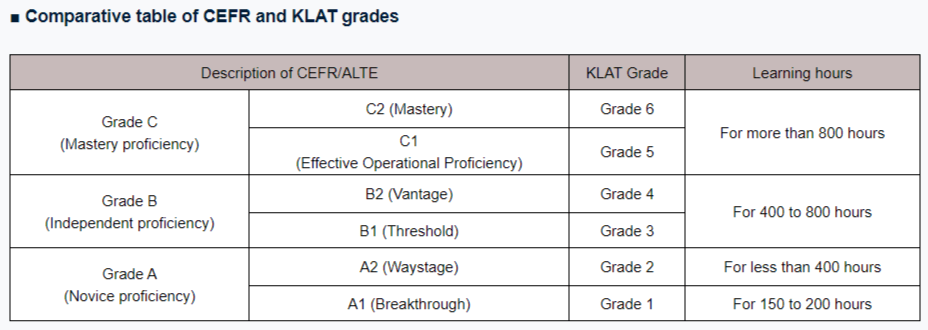
It evaluates levels from beginner to proficient: A1, A2, B1, B2, C1, and C2.
Like the European DELF, DELE, CILS, and Zertifikat Deutsch, it focuses more on the practical aspects of the language. It covers all four skills – reading, speaking, listening, and writing.
Types of KLAT exams
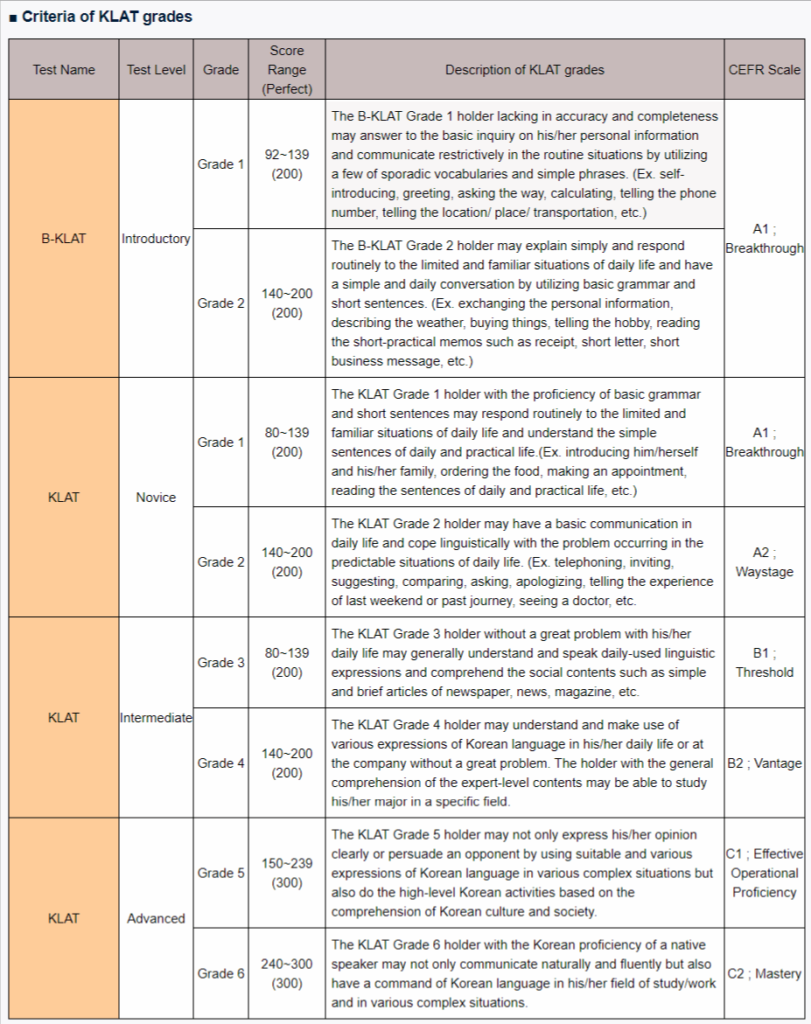
There are two kinds of KLAT tests: Beginners and Standard.
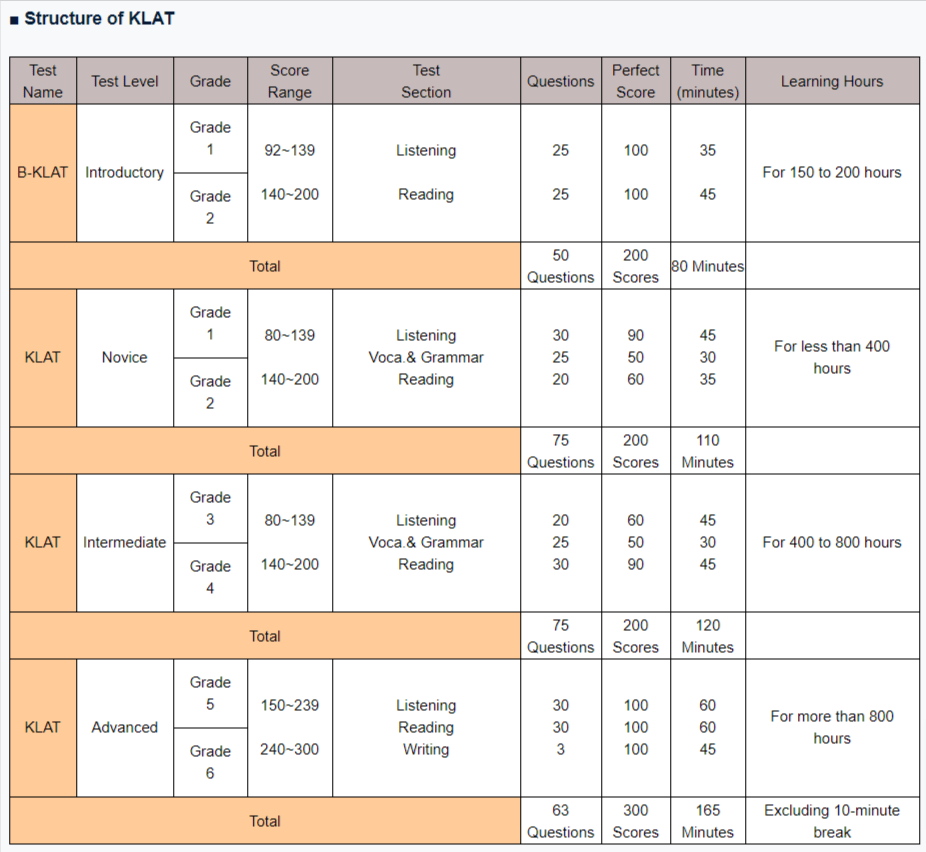
See the image below for the complete test curriculum.
Basic-KLAT
B-KLAT is an introductory test that measures the test-taker’s novice-level Korean language ability.
This is for those who have studied 150-200 hours but have not yet reached an upper-intermediate or advanced level.
It is for various job roles where a minimum level of Korean is required.
Standard KLAT
Unlike the previous one, the standard KLAT ranges from beginner to near-native level fluency in Korean.
It measures the candidates’ abilities for routine day-to-day professional, cultural, and educational activities.
The curriculum also incorporates some of Korea’s cultural characteristics.
The certification is helpful for companies, educational institutions, and schools seeking to recruit foreign employees, students, or overseas Korean speakers.
This has three broad levels:
- Beginners (level 1-2) — 200 to 400 study hours.
- Intermediate (level 3-4) — 400 to 800 hours.
- Advanced (level 5-6) — Over 800 hours.
Test structure and question formats
B-KLAT covers only two sections: listening and reading.
KLAT novice and intermediate have three parts: listening, vocabulary and grammar, and reading. In the advanced category, writing replaces vocabulary and grammar.
Please refer to the image below for test duration, passing marks, number of questions, and total marks.
Required vocabulary for grades 1 to 4
For the vocabulary needed for each level, see the table below.
| Exam Level | Grade | Vocabulary |
|---|---|---|
| Beginners | 1-2 | ~ 1500 |
| Basic | 1-2 | ~ 1800 |
| Intermediate | 3-4 | ~ 3,200 to 5,000 |
| Advanced | 5-6 | Unlimited |
KLAT test centers worldwide
As of January 2026, there are 38 testing venues in 13 countries.
In addition to Korea, centers are located in China, Japan, and Southeast and Central Asian countries such as Hong Kong, Malaysia, Mongolia, Uzbekistan, Vietnam, and Nepal.
They also organize the test in Canada, France, the Netherlands, and Germany.
2026 KLAT test dates
They conduct the test five times a year. January and May are for South Korea only, while the remaining months apply to all other nations.
| Test Dates | Registration Period | Result Dates | Locations |
|---|---|---|---|
| March 08, 2026 (Sunday) | Jan 30 (Fri) – Feb 20 (Fri) | March 17 (Tues) | Korea/Overseas |
| May 10, 2026 (Sunday) | April 03 (Fri) – April 24 (Fri) | May 19 (Tues) | Korea/Overseas |
| July 12, 2026 (Sunday) | June 05 (Fri) – June 26 (Fri) | July 21 (Tues) | Korea/Overseas |
| October 04, 2026 (Sunday) | Aug 28 (Fri) – Sep 18 (Fri) | October 13 (Tues) | Korea/Overseas |
| December 06, 2026 (Sunday) | Oct 30 (Fri) – Nov 20 (Fri) | December 15 (Tues) | Korea/Overseas |
Exam Fees
The test fee in South Korea is 40,000 KRW. The price varies for other countries.
The validity of the KLAT score
The KLAT score report is valid for 30 months after the exam date. Once it expires, you have to retake it for official work.
How to apply?
There are two ways, depending on where you’re applying.
- South Korea: You can apply online by completing the form and submitting the money (40,000 KRW) to your Shinhan Bank account.
- Other Countries: Download the form, complete it, attach your photo and identity card, and pay it into your bank account. Last, email them all the details.
Once they declare the results, you can check and verify them on the kets.or.kr site by entering your name, application number, and date of birth.
Contact
If you still have questions, call 82-2-730-0206 (Korea), email [email protected], or visit their website.
How to prepare for the exam?
On their official website, you can find plenty of sample papers, questions from the previous year’s questions, and resources to help you prepare for the KLAT test.
The Korean language has gained immense popularity recently, and there are many good reasons to learn Korean.
This has resulted in many books, audio and video lessons, teachers, apps, and online materials. You can use these resources to learn and prepare for the test.
Since Korean is a difficult language, it would help to find a Korean teacher or language school.
Do you wish to take this examination? Share your views or questions below.










Sir, I am really interested to study post-graduation in south Korea. So, please tell me the details about applying post-graduation in South Korea and how to apply?
That is too generic a question to answer. First, choose the subjects/stream, and check the available colleges offering such courses. Then apply to the respective university, depending on our budget and eligibility criteria. You may have to take IELTE and, in a few cases, also the TOPIK test.
Thank you for all the valuable information. Since I have crossed the age limit for taking TOPIK, this is great info for me. I could not find any centre in India to write the exam. Could you please guide me in giving me more info on writing/ taking this exam or centers in India?
To the best of my knowledge, there isn’t any age limit for TOPIK. You can take the test at Delhi, Chennai, Ranchi, Hyderabad, and Manipur.
Where can i take KLAT in India?
As of today, KLAT doesn’t have any test centers in India.
I am going to U.S. for my further studies which exam is suitable for my CV, KLAT or TOPIK?
You do not need these test scores on your C.V. in the USA unless you have a specific goal that requires Korean certifications. Still, TOPIK is more popular and accepted, though it has a validity of two years.
Hello! First, I would like to thank you for this informative post. I’m interested in taking KLAT, possibly this December, but I cannot find anywhere information about the location where it takes place. I mean, of course, the overseas centre. Do you by any chance know where the exam is taking place or where I can find this information? I tried emailing them, but as of now, I still haven’t received any response. Thank you in advance for your help!
The current test centers with all details like address, contact number, email, etc. are mentioned on the site. — Centers
Good day Sir, Where can I take the KLAT in Philippines? Thanks
Currently, they don’t have test center in the Philippines as per official site.
could you let me know an authentic online program to learn Korean language?
You can study from any website that offers online classes. Go with live sessions and experienced trainers.