

Do you speak Korean? If so, why not take the TOPIK test, the world’s most popular Korean language proficiency exam?
But is it worth your time, money, and effort? What can you do with a TOPIK certificate? And what are the benefits of TOPIK?
If you are still deciding and looking for some convincing reasons, this article is a perfect fit.
Here, you will find many advantages of TOPIK. So, let’s find out everything.
Importance of TOPIK
TOPIK is the most popular Korean test worldwide. It is an international standardized exam that measures Korean skills for non-native speakers.
NIIED (National Institute for International Education) certifies your Korean language ability. It is part of the Korean Ministry of Education, Science, and Technology.
This means you will earn a globally recognized certificate accepted for various purposes.
8 Definite Advantages of the TOPIK test
You may be wondering whether to take the TOPIK. And what are the advantages associated with it?
While there are several clear advantages, let’s explore the eight key benefits of TOPIK.

1. It increases the chances of getting scholarships
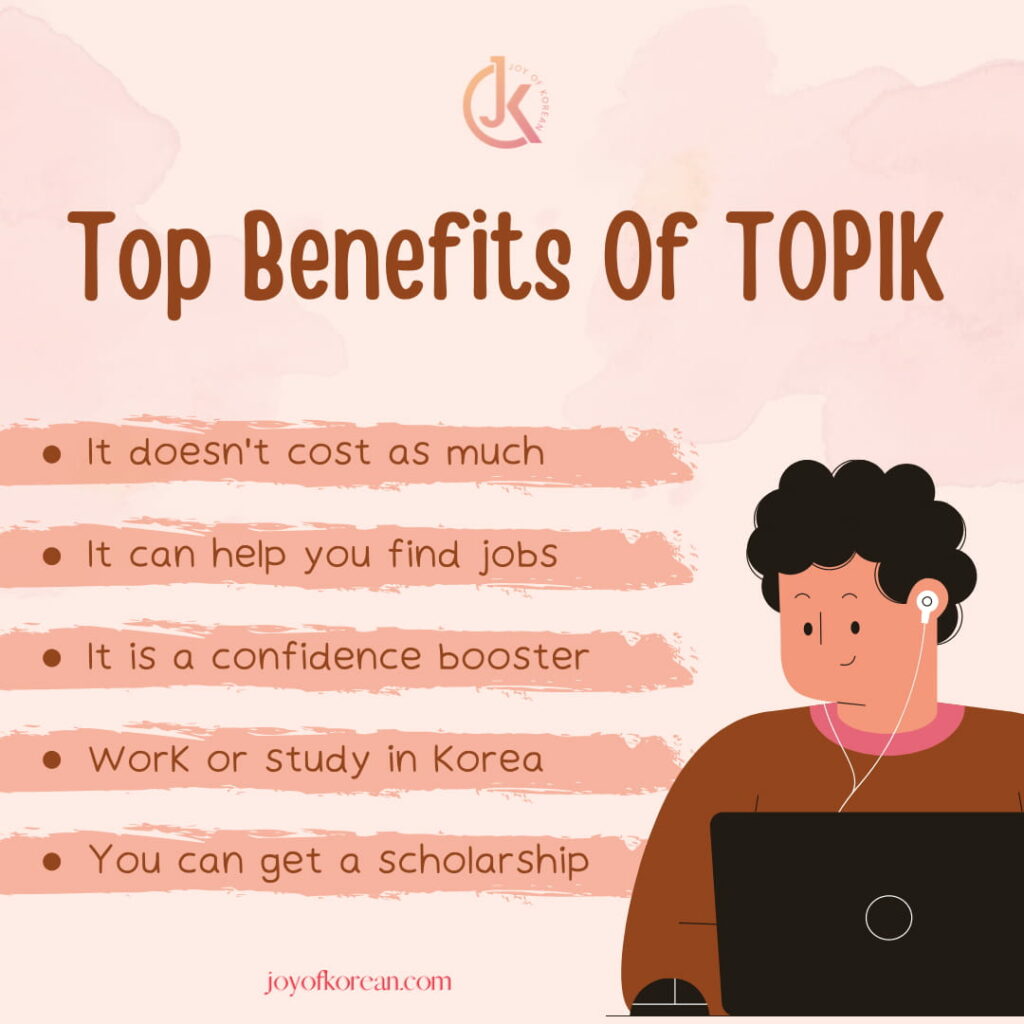
One of the top advantages of taking TOPIK is to get a scholarship to study in South Korea.
Although TOPIK might not be the primary criterion at most universities, the score increases your chances against someone with similar credentials.
Korea is home to some excellent educational institutions. A few are among the top 200 World University Rankings.
The South Korean government, companies, and several universities offer scholarships to deserving students worldwide.
GKS (Global Korean Scholarship), the best-known program, offers many opportunities. Their scholarships cover undergraduate, postgraduate, and doctoral research. The seats vary by country.
Many top-ranked Korean universities, including Seoul National University (SNU), Korea University (KU), Yonsei, POSTECH, KAIST, Hanyang, EWU, Sogang, Sungkyunkwan University (SKKU), Kyung Hee, and Hankuk, offer individual grants, rewards, and scholarships for many of their courses.
Most of these scholarship programs do not require a Korean language test score, but it can improve your chances.
Sometimes, TOPIK is even mandatory. The GKS Undergraduate course, for example, requires at least level 3. However, you have a year before the degree program begins to learn Korean and reach level 3.
2. Give your career a boost
Of all the reasons to learn a new language, career prospects are learners’ primary motivation.
In today’s global economy, many jobs require knowledge of Korean, which opens doors to career opportunities worldwide.
Let’s say you are looking for jobs in Korean organizations or companies worldwide that do business with South Korea. In that case, your ability to communicate in Korean can make your resume stand out.
The TOPIK score helps employers shortlist candidates.
An interviewer is likelier to ask, “What TOPIK level did you achieve?” instead of, “Do you understand Korean?”
Your TOPIK certification document, included in your CV, led to this result.
Many jobs, like teacher, tour guide, interpreter, translator, and content writer, are available.
If you intend to work as a Korean language specialist, aim for at least TOPIK level 5. Fluency in Korean can make you an asset and help you earn more.
3. Immigration to South Korea
The number of immigrants to South Korea has risen recently. In 2019, foreign residents accounted for 4.9% of the total population.
Korea opened its doors to foreign workers in the late 1990s, mainly in labor-intensive areas. Since then, elementary Korean language skills have become necessary for jobs.
Have you considered immigrating to Korea and applying for permanent residence?
If so, you can participate in the “Korea Immigration and Integration Program” (KIIP), which the Ministry of Justice administers.
In that scenario, the TOPIK score can play a vital role. It also benefits other visas, such as student, work, and marriage visas.
Your applications will receive preference over those of candidates who don’t have these qualifications.
4. You will know your exact level
If you’ve been learning Korean for some time, you will want to check your Korean skills. This is where the TOPIK score comes in handy.
You will discover your current knowledge and recognize your shortcomings. Then, you can focus on the areas that need improvement.
You can concentrate and give extra attention to your weaknesses to perform better in upcoming exams.
It will also encourage you to pursue more Korean language learning goals in the future.
5. It motivates and acts as a confidence booster
Another benefit of TOPIK is that it boosts your self-esteem and confidence upon passing.
This indicates success compared with other Korean learners who haven’t taken the test.
Getting a Korean certification is fun because you can brag about it with your friends. It is also tangible evidence that you have reached a certain level of Korean proficiency.
From your career and social transition perspective, it can help develop your personality.
Finally, passing is a significant morale and confidence booster.
6. Study or work in Korea
Despite being a developed nation, Korea’s cost of living is lower than in other major economies.
You can also have a once-in-a-lifetime experience of encountering cultural features. Plus, you can enjoy delicious foods, see incredible festivals, and visit beautiful tourist spots.
South Korea is monolingual. And that’s why you need a good command of the Korean language for the vast majority of work there.
TOPIK can be a great asset to your profile if you plan to pursue higher studies in Korea. Your application to various colleges and universities will get the required attention.
In addition to a comfortable stay and genuine interaction, securing a post-study job in Korea will be much easier with TOPIK certification.
Sometimes, studying at a Korean university or practicing in a Korean-speaking business world is a prerequisite.
It is also useful when applying for various roles at Korean companies. Many businesses require you to achieve a certain TOPIK level, typically 3-6.
7. TOPIK is open to everyone
If you are learning Korean, you may wish to get an official diploma or degree for various reasons. To do that, you must study at a Korean learning center.
But what if you want to self-study or learn through books, a private teacher, apps, and online resources?
After all, not everyone can attend regular Korean studies.
The solution is TOPIK!
TOPIK is the best way to improve your employment possibilities. You can also continue your education and prepare for traveling, studying, or living overseas.
The TOPIK examination is open to everyone, regardless of language skills, levels, age, nationality, or profession.
You don’t need to join any course to prove your knowledge. It is open to non-native speakers, with no set or minimum requirements.
You can prepare yourself. Then, pick the TOPIK dates, find the nearest test center, and apply. Once you pass, you will earn an international certification that everyone trusts.
8. The fee is pretty affordable
Unlike other well-known international language tests such as DELF, TEF, DELE, SIELE, TestDaF, CILS, and CAPLE, the TOPIK examination fee is affordable.
The exam fee for TOPIK 1 (levels 1 to 2) is 40,000 won, and for TOPIK 2 (levels 3 to 6), it is 55,000 won.
It is between INR 800 and INR 1,000 in India, making it one of the most reasonably priced international certification exams.
Final Words: Should you take TOPIK?

From career and scholarship to permanent residency in Korea and confirmation of one’s level, there are many definite benefits of TOPIK.
It provides the candidate with a quality Korean-level certification that is valuable for academic, personal, or professional projects.
The incentives associated with it far outweigh its potential drawbacks. And that is why the number of test-takers has grown multifold in the past two decades.
As with everything, the exam has a few disadvantages. But that is for another day.
I hope this blog article helped you understand and decide how to use your TOPIK result.
Why are you preparing for TOPIK, and what is your motivation? You can leave a comment below. I’d love to hear from you!