
Whether you study Korean to watch K-drama and K-pop or want to get a career in Korean, you may be unaware of the diverse K-varieties.
For most Korean learners outside Korea, Korean seems to be a uniform language with little to no variation across the peninsula.
You would be amazed by the vast linguistic diversity of Korean. It extends across North and South Korea, challenging the common perception of the same tongue.
That’s right!
The Korean language is a treasure trove of diversity. Today, it comprises a variety of regional varieties and creoles, each with its own distinct charm and awaiting exploration.
Koreanic is a small language family with Korean and Jeju. Most call Jeju a Korean dialect, but it is mutually unintelligible with mainland Korean types.
A dialect isn’t a distinct language or accent. It is still the same language spoken by a specific class or community in a particular region. There are often variations in vocabulary, grammar, pronunciation, and usage.
Almost all languages have dialects, such as Quebecois or Parisian French, British or American English, or Spanish in Madrid or Buenos Aires.
Many are mutually intelligible, so most can understand one another regardless of dialect. The Korean language is no exception.
Why are there so many Korean dialects?
Most dialects are spoken in widely used languages such as English, Arabic, Hindi, French, Mandarin, Spanish, and Portuguese.
However, Korean isn’t a commonly spoken tongue. Nearly 95% of native speakers, or 76 million, live in the two small countries of North and South Korea.
The diverse dialects and characteristics of the Korean language are due to several factors. This involves both nations’ geography, history, isolation, and cultural diversity.
The mountains of Korea acted as barriers. It restricted interaction between various groups of people.
Because of this seclusion, separate dialects evolved in different regions. These lingoes echoed local culture, customs, traditions, and past.
The coastal areas and islands, such as Jeju, had even less contact with the mainland, leading to a more distinct vernacular.
Korea previously had many kingdoms, like Goguryeo, Baekje, and Silla. Each had unique cultural and linguistic traits. The growth of regional speech patterns reflects past divisions, which are visible in today’s dialects.
Another reason is the lack of standardization in modern times. Before the 20th century, there was no standardized version of Korean, so each region had its own distinctive dialect.
The broader promotion of a unified Korean language occurred only after the introduction of Standard Korean. It is based on the Seoul lingo.
The North-South division is another primary reason for this variation.
After 1945, the division of Korea made dialectical contrasts more obvious. Political, cultural, governmental policies, isolation, and social changes in the North and South have shaped distinct patterns of language use.
Each variety is a unique story that reflects the people and places of origin. As a result, many Korean dialects survive today.
To learn Korean, one must become familiar with the subtle variations in its many dialects, known as 방언 or 사투리. Understanding these nuances is vital for mastering the language and fully appreciating its rich diversity.
Different Varieties of Korean Dialects
Let’s start by learning the two broad categories of Korean dialects: North Korean and South Korean.
The Korean Language Society proposed “Unified Korean Orthography” in 1933 for both Koreas.
Since the creation of the DPRK and the ROK in 1948, the two nations have followed different language policies. The decades of separation have now made a noticeable disparity between North and South Korean Koreans.
Let’s dive deep into it.
A. Korean dialects in South Korea
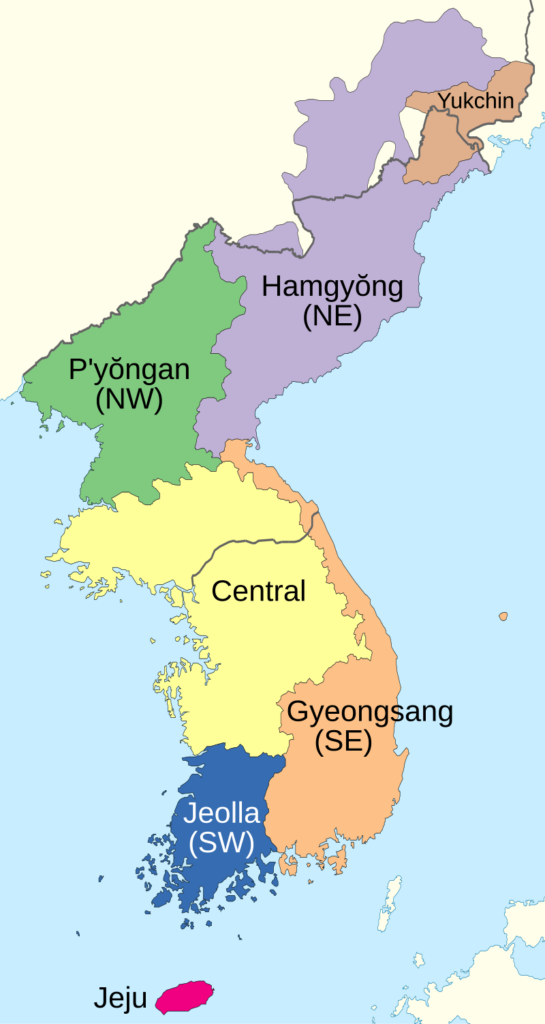
There are six main dialects of South Korea, each representing a region: Gyeonggi, Gyeongsang, Chungcheong, Gangwon, Jeolla, and Jeju.
Let’s find it.
1. Seoul Dialect (서울 사투리; 서울말) / Gyeongi (경기 방언)
The Gyeonggi dialect, also known as the Seoul dialect, is recognized as the most standard form of Korean and is widely used. It closely resembles 표준어, the official form of the Korean language.
This is the standard Korean dialect. If you study Korean for any reason, you’ll learn this variety. It is widely used in television, public discourse, the media, official documents, and education.
Although primarily spoken in Gyeonggi Province, Seoul, and Incheon, this dialect is understood by nearly everyone in South Korea.
This dialect is standard but differs in its sound, vocabulary, and usage.
Key Features of Gyeonggi /Seoul Dialect
- It has clear, smooth, and neutral pronunciation. This makes it the most intelligible dialect of Korean.
- There is minimal regional variation in the vowels and consonants.
- It has a softer and more balanced intonation than Gyeongsang (harsh) or Jeolla (musical).
- At the end of some words, the vowel 아 is realized as 어.
- Polite speech endings like -요 (-yo) and formal endings like – 습니다 (- seumnida) are common.
E.g., “What are you doing?” — “뭐 하세요?” (Mwo haseyo?) - This dialect uses a vocabulary similar to that found in South Korean textbooks, media, and official documents. Unlike other regional dialects, it does not have unique or local words.
- People often see it as casual, polite, and formal. This makes it suitable and flexible for various situations and social settings.
2. Gyeongsang Dialect (경상도 방언)
The Gyeongsang dialects (Southeastern Korean) originate from the historical region of Gyeongsang Province.
This area is now divided into Daegu, Busan, and Ulsan, and the North and South Gyeongsang Provinces. It is one of the most recognizable and distinct Korean dialects.
The dialects of the three cities, Busan, Ulsan, and Daegu, differ slightly, with the Busan variant being the most famous.
Key Features ofthe Gyeongsang Dialect
- It has an energetic, fast intonation with a rougher sound. Tones and pitch are used more prominently, making it different. For example, the verb “있다” (to exist) may have a distinct pitch from the standard dialect of Gyeonggi.
- Unlike Standard Korean, which relies on stress and rhythm, this variety employs a pitch-accent system.
- Words that are spelled the same can have different meanings based on their pitch. For example, 말 (mal) spoken with a high pitch means “speech,” while 말 (mal) spoken with a low pitch means “horse.”
- The vowelsㅐ(ae) and ㅔ(e) are often mixed in standard, but it’s evident in this dialect.
Example: 내 (nae) (“I”) and 네 (ne) (“you”) are pronounced in a way that is easy to tell apart. - Common words and phrases are shortened, creating a fast-paced style of speaking.
Example: Standard: “왜 그래?” (Wae geurae?) Gyeongsang: “와 그러노?” (Wa geureono?). - It often employs informal particles such as -노 and -가. It adds a chatty and assertive tone.
Example: “맞다 아이가?” (Mata aiga?): “That’s right, isn’t it?” - The endings -노 (-no) and -가 (-ga) are typical, replacing -요 (-yo).
Example: Standard: “뭐 해요?” (Mwo haeyo?) Gyeongsang: “머하노?” (Meo hano?). - Negative constructions can vary slightly from those in Standard.
Example: 못 (mot) (Standard) becomes 몬 (mon) in Gyeongsang.
3. Jeolla Dialect (전라도 방언)
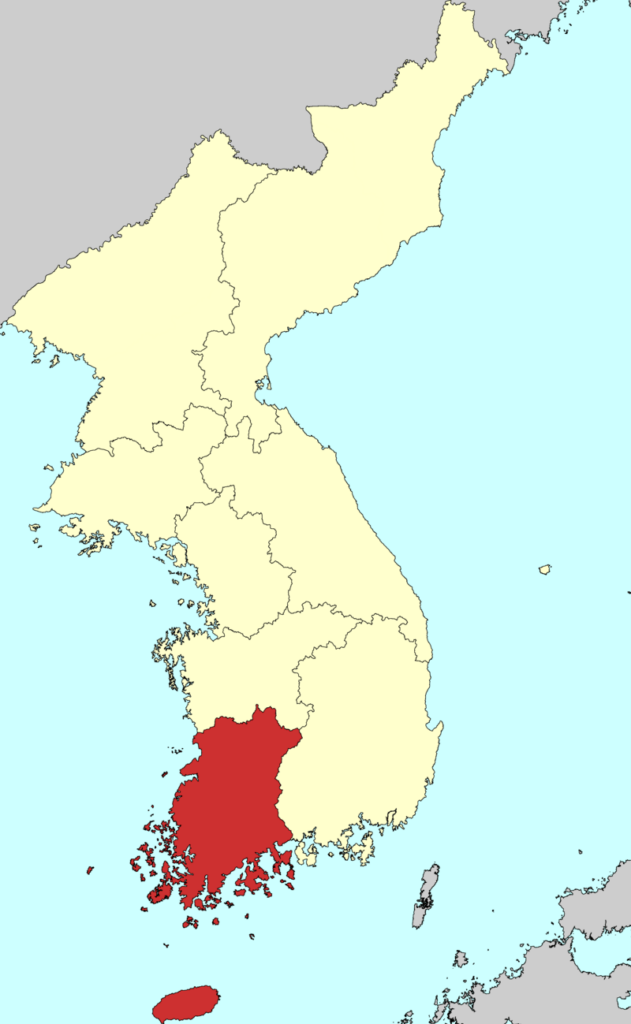
The Jeolla dialect (Southwestern Korean) is spoken in the Jeolla (Honam) region of South Korea. This includes the metropolitan city of Gwangju.
This area was called Jeolla Province during the Joseon era. Much like the Chungcheong dialect, the Jeolla lacks official standard status. Pansori text is written using the Jeolla version.
To learn more about the Jeolla dialect, I suggest watching the movie “Sunset in My Hometown.”
Key Features of Jeolla Dialect
- This is fast, but not as quick as the Seoul dialect. It is less dynamic and intense than the Gyeongsang one, but it still makes speakers sound enthusiastic and funny.
- The Jeolla one is more informal and has pleasant expressions.
- It has a softer, more melodic intonation and a stronger emphasis on vowel sounds. Certain sentence endings, such as “~잉” and “~쥬,” are unique features.
Example: “먹었어?” (Did you eat?) — “머겄어잉?” - The final syllables of sentences are often long, making the sound more casual and friendly.
- It has -잉 (-ing) as a sentence-ending particle. It shows focus and friendliness. Example: Standard: “괜찮아요?” (Gwaenchanayo?) Jeolla: “괜찮잉?” (Gwaenchang-ing?)
- Casual ends like -라잉 (-raing) and -그라잉 (-geuraing) are typical.
Example: Standard: “알았어요.” (Arasseoyo.) Jeolla: “알았당께~” (Arattangke~.) - It contains unique words that distinguish it from others.
Examples:
“어떻게?” (Eotteoke?) — Jeolla: “어쩐당가?” (Eojjeondangga?): How?
“그지요?” (Geuji-yo?) — Jeolla: “그잖아잉?” (Geujana-ing?): Isn’t that right? - Phrases such as “당께” (dangke), which means “so” or “thus,” are expected of the Jeolla dialect.
- Verb endings are simple.
Example: Standard: “뭐 하세요?” (Mwo haseyo?) Jeolla: “머 혀?” (Meo hyeo?)
4. Chungcheong Dialect (충청도 방언)
Chungcheong is primarily spoken in the Chungcheong province in west-central South Korea, including the large city of Daejeon.
The Chungcheong dialect has two major categories: the Northern, similar to Gyeonggi, and the Southern, akin to Jeolla.
This variety of Korean is calm and modest. People in this area often speak more slowly and seem friendlier than elsewhere.
Key Features of the Chungcheong Dialect
- A slower speech rate, vowel changes, unique terms, a relaxed speech pattern, and a wide pitch range characterize it.
- A unique feature is the powerful word 뭐여 (mwoyeo), which can be used in almost any situation.
- Distinct sentence endings like “~유” are common. Standard: “맞아요.” (Majayo.) Chungcheong: “맞아유.” (Majayyu.)
- The endings -슈 (-syu) and -여 (-yeo) are regular to make a more friendly tone. Example: Standard: “뭐 하세요?” (Mwo haseyo?) Chungcheong: “뭘 혀유?” (Mweol hyeoyyu?)
- Declarative sentences often end with a rising pitch. It appears to be questions addressed to speakers of other dialects.
Example: Standard: “그렇죠.” (Geureochyo.) Chungcheong: “그렇슈?” (Geureosyu?) - It makes some verb forms simpler and sounds casual.
Example: “해야 돼요.” (Haeya dwaeyo) — “혀야 되유.” (Hyeoya dweeyyu). - Many local words and phrases exist:
“저기요” (Jeogiyo) → “어유” (Eoyu): Hey there / Excuse me.
“그렇지요?” (Geureochijyo?) — “그렇슈?” (Geureosyu?): Isn’t that right?
5. Gangwon Dialect (강원도 방언)
The Gangwon dialect is spoken in the province of Gangwon in South Korea and Kangwŏn in North Korea. These provinces are immense but have relatively small populations.
Numerous mountains and forests characterize this area. Because of centuries of isolation, they developed their own dialect. In 2018, the PyeongChang Olympic Games took place in this province.
The dialect resembles Seoul’s but features a distinct vocabulary, particularly in mountainous regions. Older forms may also influence more remote areas.
Key Features of Gangwon Dialect
- The cadence rises slightly at the end of the sentences, adding a questioning or warm tone.
- ㅆ (ss) sounds like ㅅ (s).
- At the end of a sentence,ㅏ changes to ㅓ.
- At the sentence end, the standard 아 (ah) sound changes to 어 (eo).
- Questions can also end in 나 (na), -노 (no), -고 (go), -가 (ga).
- The suffix -다리 is used to express assurance or force.
Example: Standard: “맞아요.” (Majayo.) Gangwon: “맞다리.” (Majdari.) - End-구만 is used to agree, similar to “Oh, I see” in English.
Example: Standard: “그렇구나.” (Geureokuna.) Gangwon: “그렇구만.” (Geureokuman.) - As with others, it can be simplified or modified.
Example: Standard: “뭐 하고 있어요?” (Mwo hago isseoyo?) Gangwon: “뭐 혀?” (Mwo hyeo?) - The dialect has a casual and friendly tone. It reflects the easygoing nature of people in Gangwon.
6. Korean dialects in Jeju Dialect (제주어 / 제주 방언)
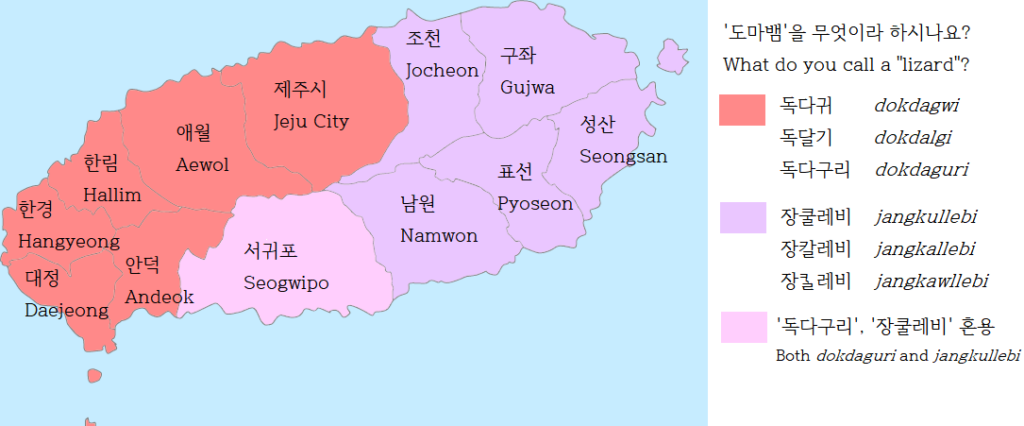
The Jeju dialect, also known as the Jeju language (제주어), is a distinct variety of Korean. It is spoken on Jeju Island off the southern coast of South Korea.
Many linguists consider Jeju a distinct language due to significant differences between Jeju, standard Korean, and other regional dialects.
Key Features of Jeju Dialect
- Pronunciation differs vastly. Some consonants and vowels are softened, whereas others retain older Korean forms.
Standard Korean: “무엇” (mueot) → Jeju: “무사” (musa) for “what” or “why.” - The vocabulary and grammar are unique, shaped by past interactions with other areas and languages.
Example: “어디 가세요?” (Where are you going?) → “어디 감수광? - This honorific ending is unique to Jeju and is used to show respect.
Example: Standard: “하세요?” (Haseyo?) Jeju: “햄수꽈?” (Haem-sukwa?) - The ending -염 is commonly used to add a sociable tone.
Example: Standard: “먹어요.” (Meogeoyo.) Jeju: “먹어염.” (Meogoyeom.) - Jeju-eo has a vast, distinctive vocabulary, unlike that of any other dialect.
Examples: “하르방” (Hareubang): Grandfather, “멍에” (Meong-e): Cow’s harness, “궷다” (Gwetta): To dig up. - It keeps grammatical structures and markers from Middle Korean.
Example: Standard: “있어요.” (Isseoyo.) Jeju: “이시다.” (Isida).
B. Korean dialects in North Korea
Today, North Koreans and South Koreans can easily communicate. This is because the two countries’ main languages primarily derive from a 1936 document by the Korean Language Society.
Korean dialects in North Korea can be grouped by region. They are similar to South Korean dialects but exhibit unique characteristics due to various factors over many decades.
Here’s an overview of the major dialects in North Korea.
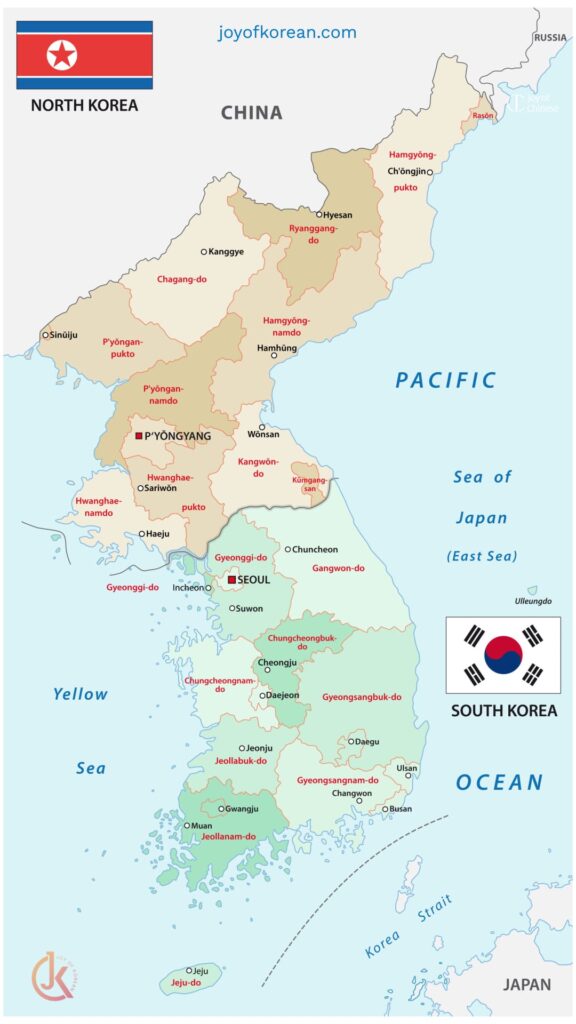
7. Pyongan Dialect (평안 방언)
Pyongan Dialect (also known as Northwestern or Munhwaŏ / 문화어) is the standardized form of Korean and the official language of the Democratic People’s Republic of Korea (DPRK).
It is extensively used in Pyongyang, North Pyeongan, South Pyeongan, and Chagang Province. It is also helpful in Yanbian and other neighboring Chinese regions.
The core ideologies and government policies have vastly influenced it. This dialect is common in education and media.
Key Features of Pyongan (Munhwaŏ) Dialect
- It employs a unique vocabulary and expressions not found in South Korea, yet local traditions and socialist principles influence it.
E.g., Computer (전자계산 / 컴퓨터) and Hand Phone (핸드폰 / 손전화). - This has simpler intonation and pronunciation than that of Seoul Koreans. This one has many Sino-Korean characters.
For instance, (why) 왜 – 외, (cold water) 연냉수 – 랭수, and (girl) 여자 – 녀자. - Unlike the Jeolla and Gyeongsang dialects, the Pyongan one lacks melodic intonation.
- Certain sounds differ. Vowel “ㅓ” (eo), which may sometimes sound closer to “ㅗ” (o). “ㄹ” (r/l) at the end of syllables may sound more apparent. It also omits or softens “ㅎ” (h) in everyday speech.
- Verb endings are often shorter or distinct
Standard: “-아요/-어요” (-ayo/-eoyo) — Pyongan: “-오” (-o).
Example: Standard: “괜찮아요.” (Gwaenchanayo.) Pyongan: “괜찮소.” (Gwaenchanso.) - South Koreans use many foreign loanwords and Konglish (Korean English). Because of North Korea’s isolation, Pyongyang adopts a more conventional approach, reinforcing the use of Korean-derived terms. That is why it has fewer foreign words.
8. Hwanghae Dialect (황해도 방언)
The Hwanghae dialect is helpful in the Hwanghae region, which includes Hwanghae (North Korea), South Korea’s Gyeonggi Province, and Incheon.
The Hwanghae region is near the North-South Korean border. It reflects features of both the Pyeongan and Gyeonggi dialects and exhibits characteristics of both North and South Korean languages.
This makes it somewhat distinct from other colloquial spoken varieties further south in South Korea, such as the Gyeongsang or Jeolla dialects.
Its distinct pronunciation, unique accents and intonation, vocabulary, and certain grammatical elements set it apart from standard Korean.
Key Features of Hwanghae Dialect
- Some consonants and vowels differ slightly from those of standard Korean. Vowels like “ㅏ” and “ㅓ” can sound more open.
- Many words differ from one another, creating difficulties in communication between speakers from different regions. It uses unique words influenced by regional history and culture.
- Subtle grammatical differences, such as sentence endings, particles, and verb forms, may differ from standard Korean.
- Frequent use of -소 (-so) in polite and formal speech.
Example: Standard: “하세요.” (Haseyo.) Hwanghae: “하소.” (Haso.) - Use of -라우 (-rau): A formal yet commanding tone.
Example: Standard: “앉으세요.” (Anjuseyo.) Hwanghae: “앉으라우.” (Anjurau.) - Addition of -네라 (-nera) for gentle emphasis.
Example: Standard: “그렇군요.” (Geureokunyo.) Hwanghae: “그렇네라.” (Geureonera.) - Verb endings are often shorter or more casual.
Example: Standard: “-지 않아요” (-ji anhayo) → Hwanghae: “-지 않소” (-ji anso)
9. Hamgyong Dialect (함경 방언)
Hamgyong (also known as Northeast) is another dialect spoken in the northern and southern Hamgyŏng and Ryanggang provinces of northeastern North Korea. Because of Korea’s division, you will rarely hear about it in South Korea.
Distinctive linguistic features characterize this variant.
Key Features of the Hamgyong Dialect
- This dialect tends toward nasalization, giving it a sharp, strong, and unique sound. The vowels /ㅓ/ (eo) and /ㅗ/ (o) often differ from other dialects.
- For example, “없다” (eopda, meaning “to not exist”) might sound with a slightly altered vowel tone. These have distinct consonants and are more aspirated or emphatic than in standard Korean.
- It has its own verb endings and particles that differ from those of other dialects. For example, in Hamgyong, people use the polite ending “라요” (ra-yo) rather than the standard Korean ending “세요” (see).
- It has many unique words related to food, clothing, and farming. Because it is close to Russia and China, particularly the neighboring province of Jilin, it has borrowed loanwords and sound influences from these languages.
- Contrary to the softer tones of the central dialects, this has a harsher, more abrupt pitch. The speech patterns are often clipped, giving the speech a distinctive rhythm.
- It employs uncommon forms of consonant doubling, particularly for speech intensity.
Example: “밝다” (balgda) becomes “빨르다” (ppallda) in some areas.
Final Words: Which Korean dialects should you learn?
Most Korean students, particularly beginners, needn’t worry about learning various Korean dialects. Knowing the standard (Seoul dialect) is enough to communicate effectively nationwide.
Seoul is the only official standard, although there are nine Korean varieties in North and South Korea. The Pyeongan (Munhwaŏ) is an official designation in North Korea, which is not dissimilar to Seoul (Gyeonggi).
Learning regional dialects can be helpful, depending on your goals and interests. If you intend to live in those areas or work with them, it can significantly deepen your connection to Korean culture and communities.
Each Korean type is unique, and some are difficult to grasp. Yet most people understand one another without difficulty. This is due to the high mutual intelligibility among dialects.
I hope this post has helped you identify the most prevalent Korean dialects and what distinguishes them.
If you want to share your thoughts, share them in the comment section below.